 |
2016 Lowell Thomas Awardees "Celebrating the Legacy of Open Spaces"
Left-to-Right: Kristine Tompkins, Rick Ridgeway, Laly Lichtenfeld, Martin von Hildebrand.
photograph(s) © copyright, ROBERT GLENN KETCHUM, 2016, @RbtGlennKetchum @LittleBearProd #LittleBearProd
|

@LittleBearProd Blog
Shop Sundance Catalog

Wednesday, November 2, 2016
The Lowell Thomas Award 2016

Monday, October 31, 2016
Weekly Post, Where It All Began: LIMEKILN CREEK by Robert Glenn Ketchum
Where It All Began: Limekiln Creek by Robert Glenn Ketchum
In 1967, I discovered Limekiln Creek on the Big Sur Coast in California. Among those redwoods, I had an epiphany as a young artist. As a photographer, most of the skills I would use, I would learn there. Many years later in a mature career, I helped the American Land Conservancy acquire this property for the California State Park system. This is the story of a very personal place.
Monday, October 31, 2016

Where It All Began - Limekiln Creek, #44: This is a preface to this blog and the last post. In discovering AND then returning to Limekiln, I was inspired to change the direction of my work, and to greatly improve the quality of my photography - these decisions affected my life. Simultaneously I also had other important influences. My parents began leasing a house in Sun Valley (ID), from which some of my earliest published images were created ( SEE MY BLOG about the Decker Flats Climbing & Frisbee Club ). Then in transit to Sun Valley for a visit, as with Limekiln, I randomly discovered an amazing place in the desert that became to body of work, STONED IMMACULATE, a new blog that will begin next week in this spot. The above image is Paul Caponigro's "Apple, New York" 1964, or so it was titled when first published in Aperture magazine. At UCLA, a Robert Heinecken assignment had each of us choose a photographer "outside" of "our genre" and prepare a report/lecture with slides for a class presentation. Although I was "leaning" toward an interest in landscape, I still thought it less exciting than my experimental, hand-colored work, and Caponigro's work, which lacked the drama of Ansel Adams, seemed especially "quiet." I chose him because I viewed him boring and thought I would make that my lecture point, BUT the more I studied his images, the more I grew to understand what he saw. Then there was the final image, the endpiece of the publication. When presenting to the class, I said this was a great final image because it suggested he was doing "newer, more experimental work," and Heinecken asked, "How's that?" I responded that most his other images were landscapes, but this one of the night sky seemed more adventurous. Uniformly the class mumbled oddly, and then my friend, Bob Jenkins, spoke up and said, "What are you smoking, man? THAT is an apple." Having NOT read the image title, I missed that detail, but once he said it, I could see it. In fact, I could still see BOTH. This duality of being a "straight" photograph AND ALSO of "another world entirely" would become a subtext of my work for the rest of my life. In telling that story to workshop students once, I did not notice that Caponigro had come into the back of the classroom. After speaking, I took questions, and the last hand up was his. When he rose, I knew him, so I introduced him to the class. Paul said he was glad to hear that story and know the image affected me in that way, AND then he said I should tell Heinecken that "it WAS the night sky." He has since changed the title of this image to "Galaxy Apple."
photograph(s) © copyright, JOHN PAUL CAPONIGRO, 2016, @LittleBearProd, #LittleBearProd, ALC (@american_land), Monterey Pop Festival (@MontereyPopFest)
_______________________________________________________
Wednesday, October 26, 2016
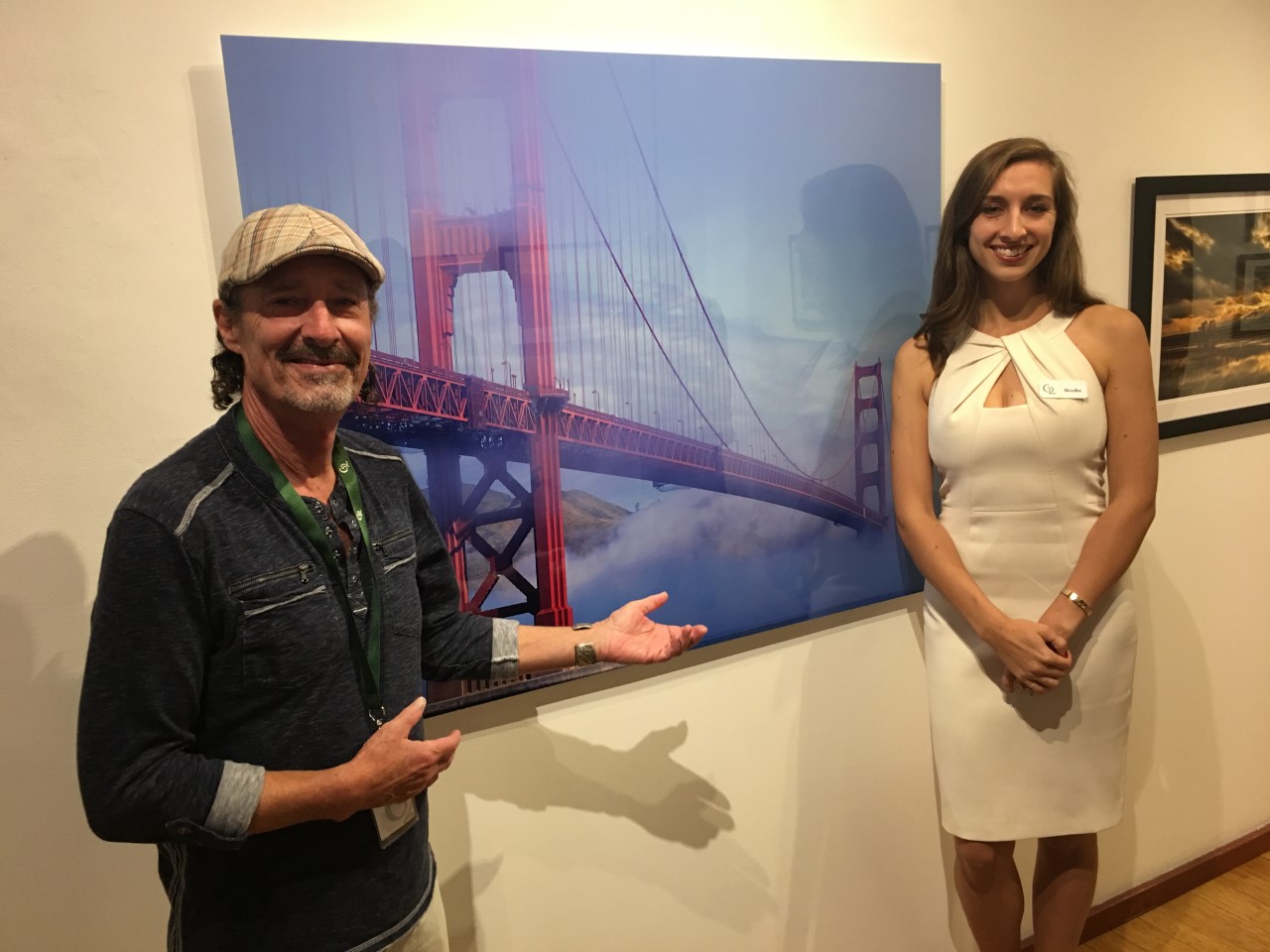
The G2 Gallery Exhibit, " 100 Years of National Parks: The West"
If you have not done so, please come to The G2 Gallery in Venice, California and enjoy the exhibit of western national parks in celebration of their 100th Anniversary.

Thursday, September 15, 2016
NRDC & IUCN in Politico - #NoPebbleMine

Since the International Union for the Conservation of Nature @IUCN has recommended protecting southwest AK and Bristol Bay from the industrial development of the Pebble mine, Joel Reynolds, @NRDC (Natural Resources Defense Council), and I want to be sure our political leaders are aware of their resolution, so yesterday, this ad dropped in POLITICO.
Contact President Obama and the @EPA and tell them now is the time to act to permanently protect this remarkable ecosystem and the invaluable fishery. Now THE WORLD really is watching!
~Robert Glenn Ketchum
NRDC at the IUCN World Conservation Congress - #NoPebbleMine
 Working with my good friend, Joel Reynolds and his amazing staff at @NRDC (Natural Resources Defense Council), who hosted a reception for the International Union for Conservation of Nature @IUCN World Conservation Congress attendees in Hawaii...
Wednesday, August 31, 2016
Earth To Pebble Mine: Stay Away From Bristol Bay. World Conservation Congress Registers Overwhelming International Opposition to Mega-Mine That Threatens Bristol Bay’s Wild Salmon Fishery by Joel Reynolds

Earth To Pebble Mine: Stay Away From Bristol Bay. World Conservation Congress Registers Overwhelming International Opposition to Mega-Mine That Threatens Bristol Bay’s Wild Salmon Fishery
by Joel Reynolds,
Western Director and Senior Attorney, NRDC, Los Angeles
A new chapter opened today in the battle against the proposed Pebble Mine, as the World Conservation Congress overwhelmingly adopted a motion opposing the embattled mega-mine and other large-scale mining in the Bristol Bay region of southwest Alaska and urging the U.S. government to prevent the issuance of permits. With this action, an international body has for the first time formally joined longstanding opposition to the massive copper and gold project — a project that, for years, has been the focus of a relentless, broad-based campaign in Alaska and the lower 48 states to stop it.
Tuesday, August 16, 2016
TATSHENSHINI: Saving a River Wild
TATSHENSHINI: Saving a River Wild by Robert Glenn Ketchum
In 1990, I was invited on a 10-day float down the Tatshenshini, a huge river system flowing from Western Canada to the Pacific Ocean that literally divides two of North America's largest national parks, Canada's Kluane National Park and Alaska's Glacier Bay National Park. A gold mine was being proposed mid-river. I broke the story in LIFE magazine. There were many other articles and a book. The mine was never developed and the river is now a wilderness corridor. This is a conservation SUCCESS story!
Tuesday, August 16, 2016

Tuesday, August 16, 2016

TATSHENSHINI: Saving a River Wild, #115
TATSHENSHINI - Saving a River Wild, #115: Looking back at where we had come from on the previous evening, you can see that there is some open water close to the shore. It is very shallow here, so the larger bergs ground before reaching this point. The ice that is here is small enough that most of it can be pushed around and thus the guides have gone back into the water to pull the rafts through and around the obstacles in these shallows, and get them over to the open water of the outflowing Alsek river below the massive ice jam. Once again our collective camp trudges the gear across the broad beach to where the boats will be reloaded. Having finished that, most of us are pondering our last views of this place and I am marveling that we made it at all. Again, scale fails me, BUT that blue berg is the size of a small house. It, and those really dirty ones on either side, have completely sealed off ANY path through where we past last night. As we would eventually learn, the next six river float groups to follow during the ensuing week had to be picked up by helicopter from the bar where we had our late lunch. There was NO passage through this to the outlet and no one could float on to the airstrip pick-up.
photograph(s) © copyright, ROBERT GLENN KETCHUM, 2016, @RbtGlennKetchum @LittleBearProd #LittleBearProd #Tatshenshini @glacierbaynps @Life @Wilderness #WeAreTheWild @nature_AK
Follow Robert Glenn Ketchum's Photographic Activism & Art Online:
WEBSITE: http://www.robertglennketchum.com/
VISIT OUR STORE: http://shop.littlebearprod.com/Artist-Robert-Glenn-Ketchum_c57.htm
SOCIAL MEDIA by @LittleBearProd: http://www.LittleBearProd.com
____________________________________________________
Book, "The Topsy-Turvy Path to Twenty-first-Century Socialism The Limitations of the New Left in Latin America" by Nicole Fabricant

The Topsy-Turvy Path to Twenty-first-Century Socialism. The Limitations of the New Left in Latin America
by Nicole Fabricant
Book Review of:
Latin America’s Turbulent Transitions: The Future of Twenty-first-Century Socialism.
by Roger Burbach, Michael Fox, Federico Fuentes
London and New York: Zed Books, 2013.
Monday, August 15, 2016
Abstract, Latin American Studies: Publishing and Politics by Ronaldo Munck
:::::: Abstract ::::::
Latin American Studies: Publishing and Politics
by Ronaldo Munck
This is an opportune moment, I believe, to debate the future of Latin American studies journals, given their variety and well-established nature. My own standpoint derives from a long-term membership of the Latin American Perspectives advisory panel and a brief stint as chief editor of the Bulletin of Latin American Research (UK) as well as membership of around a dozen editorial boards of journals dedicated to labor and globalization studies. And, of course, as has any other active researcher I have faced the demands made by the powers that be on where we should publish and what we should publish.

by Ronaldo Munck
This is an opportune moment, I believe, to debate the future of Latin American studies journals, given their variety and well-established nature. My own standpoint derives from a long-term membership of the Latin American Perspectives advisory panel and a brief stint as chief editor of the Bulletin of Latin American Research (UK) as well as membership of around a dozen editorial boards of journals dedicated to labor and globalization studies. And, of course, as has any other active researcher I have faced the demands made by the powers that be on where we should publish and what we should publish.
Friday, August 12, 2016
Abstract, A View from the North by Rory M. Miller
:::::: Abstract ::::::
A View from the North
by Rory M. Miller
Having spent a significant part of my career editing the two major interdisciplinary journals on Latin America published in the United Kingdom, I have thought for years about what our role as editors should be in terms of linking different traditions of Latin American studies—North American, European (in all their various national guises), and Latin American (again, in all their various national guises). There were clear differences between the two journals. The Bulletin of Latin American Research was the journal of the (UK) Society for Latin American Studies, so one could envisage the “typical” reader as one of the 200 or so who attended annual conferences; the Journal of Latin American Studies, one of the two or three leaders internationally in the field, presented different challenges, since its readership was much broader and its reach much more global, evident in the fact that roughly 40 percent of submissions came from North America. (I should emphasize here that what follows is my personal view, not that of my editorial colleagues or the publisher of either journal.)
In the end I would hope that the Journal of Latin American …
CLICK TO READ THE FULL ARTICLE
Latin American Perspectives
July 2016 vol. 43 no. 4 Abstract, pages 116-118
by Rory M. Miller
Having spent a significant part of my career editing the two major interdisciplinary journals on Latin America published in the United Kingdom, I have thought for years about what our role as editors should be in terms of linking different traditions of Latin American studies—North American, European (in all their various national guises), and Latin American (again, in all their various national guises). There were clear differences between the two journals. The Bulletin of Latin American Research was the journal of the (UK) Society for Latin American Studies, so one could envisage the “typical” reader as one of the 200 or so who attended annual conferences; the Journal of Latin American Studies, one of the two or three leaders internationally in the field, presented different challenges, since its readership was much broader and its reach much more global, evident in the fact that roughly 40 percent of submissions came from North America. (I should emphasize here that what follows is my personal view, not that of my editorial colleagues or the publisher of either journal.)
In the end I would hope that the Journal of Latin American …
CLICK TO READ THE FULL ARTICLE
Latin American Perspectives
July 2016 vol. 43 no. 4 Abstract, pages 116-118
Subscribe to:
Posts (Atom)
Shop Sundance Catalog
